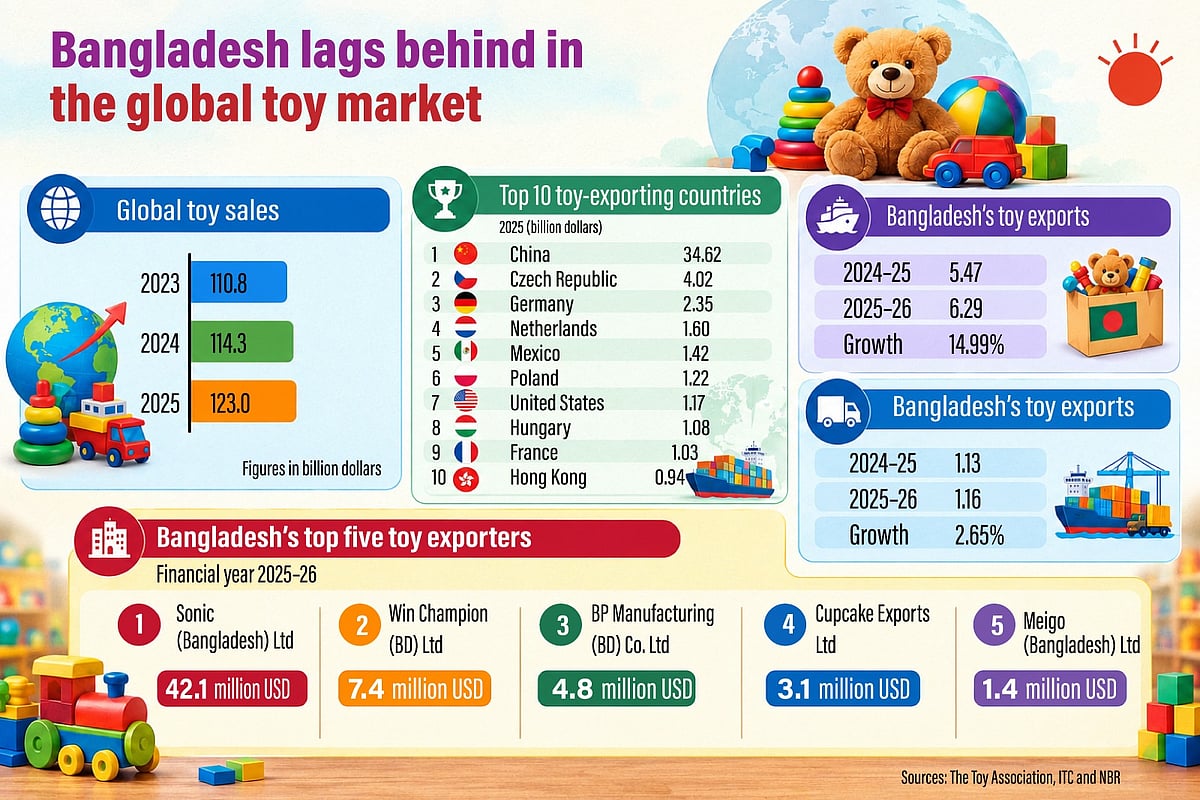
The global toy market represents a massive economic frontier, valued at approximately USD 123 billion. While regional powerhouses like China dominated this colossal industry by exporting toys worth USD 34.82 billion last year, Bangladesh managed a meager USD 62.9 million. Although the country experienced nearly 15 per cent growth in toy exports during the last fiscal year, it has largely failed to capitalize on the opportunity to capture a meaningful share of the expansive international marketplace, leaving its true economic potential underutilized.
Industry insiders and entrepreneurs point out that the sector is continuously falling behind due to a web of complicated systemic hurdles. Key challenges include persistent bottlenecks in importing raw materials, a glaring lack of targeted policy support, the absence of a coordinated national strategy to elevate product quality, and frequent, disruptive power outages. While a few foreign-backed manufacturing facilities have made notable strides in their export volumes, domestic entrepreneurs are forced to navigate an array of bureaucratic and structural obstacles that impede their growth.

The global landscape for toys is evolving rapidly, with surging demand not only among young children but also extending to teenagers for various specialized and electronic gadgets. Yet, Bangladesh's annual export earnings from toys have historically hovered stubbornly between USD 50 million and USD 60 million. This stagnation highlights a stark disconnect between domestic manufacturing capabilities and the aggressive expansion trends observed in the worldwide consumer market.
Local manufacturers have long emphasized the necessity of product diversification to scale up exports. In contemporary global retail, numerous fashion brands and international department stores successfully retail toys alongside ready-made garments. Given Bangladesh's globally recognized prowess in the apparel sector, leveraging these existing retail channels presents a highly accessible pathway for expanding toy exports. Projections by the Dhaka Chamber of Commerce and Industry (DCCI) suggest that the domestic toy market alone could double to reach Tk 90 billion by 2030 if properly nurtured.
Much like garment manufacturing, producing toys for international export requires strict adherence to stringent buyer specifications, safety protocols, and rigorous quality benchmarks. Local factories frequently struggle to meet these global standards without state-of-the-art testing facilities and institutional backing. Industry leaders argue that overcoming these barriers requires dedicated industrial zones, simplified tariff structures for raw material imports, and proactive diplomacy to attract foreign direct investment into the sector.
Ultimately, transforming Bangladesh into a formidable player in the global toy manufacturing ecosystem requires a concerted public-private partnership. By replicating the successful policy frameworks that bolstered the readymade garment industry—such as cash incentives, tax holidays, and streamlined customs procedures—Bangladesh can unlock the vast potential of its toy sector, generating substantial foreign exchange and diversifying its narrow export basket.