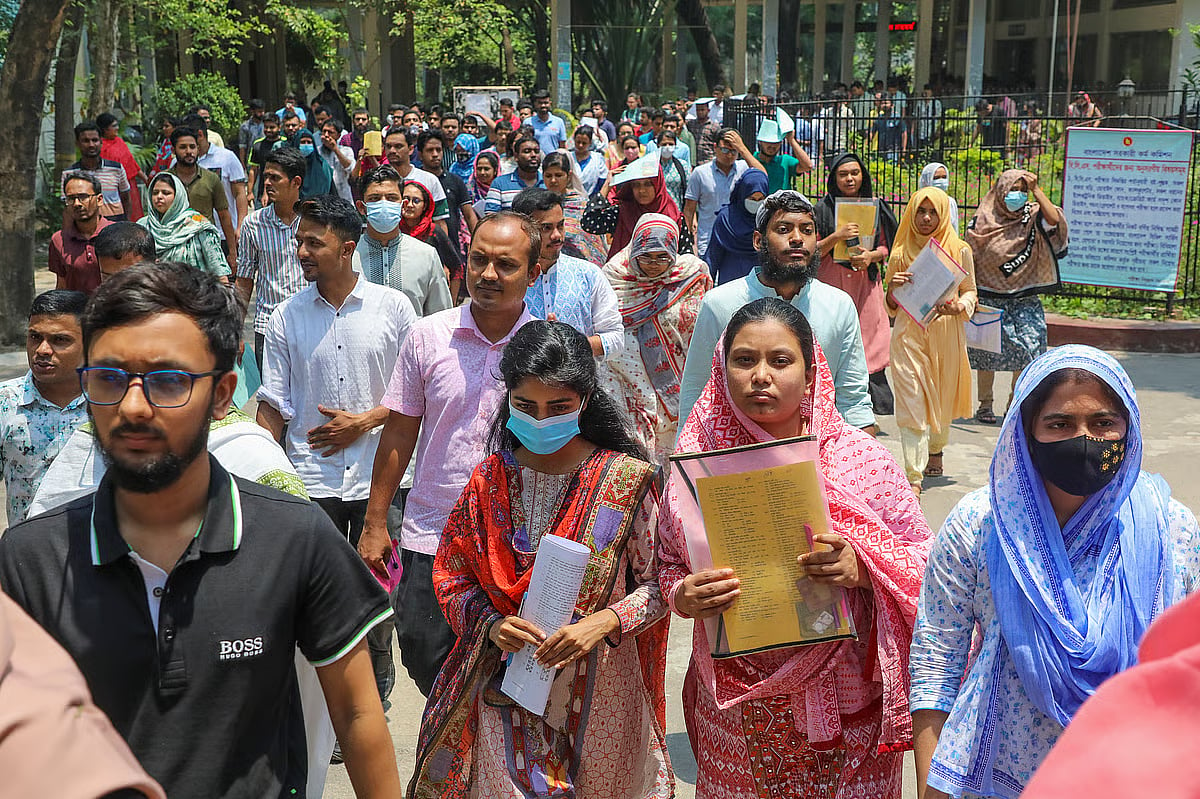
The grueling journey of the Bangladesh Civil Service (BCS) examinations, which culminates in the ultimate dream of public service for thousands of hopefuls, has turned into a nightmare for several top-tier candidates. Despite successfully navigating the rigorous preliminary, written, and viva voce stages and earning official recommendations from the Bangladesh Public Service Commission (BPSC), numerous candidates have found their names inexplicably missing from final government gazette notifications.
Take the case of Shubhra Debnath, who successfully cleared the preliminary, written, and oral examinations for both the 48th BCS (Special) and the 45th BCS. Having earned recommendations from the BPSC for the health cadre, he expected his career path to be securely laid out. However, his name was conspicuously absent from the 45th BCS gazette notification, just as it had been omitted from the 48th BCS (Special) gazette published earlier. Furthermore, though recommended for the police cadre in the 46th BCS, he now lives in constant anxiety that he might face a similar fate once again.

According to administrative data, the Ministry of Public Administration recently issued the final gazette for the 45th BCS, appointing 1,702 candidates. However, when the BPSC originally finalized and submitted its recommendation list nearly eleven months prior, it contained 1,807 names. This mathematical discrepancy reveals that a staggering 105 candidates were dropped between the commission's recommendation and the ministry's final gazette release. While 49 candidates reportedly did not participate in mandatory physical examinations and associated bureaucratic procedures, the remaining 56 candidates were dropped outright, including nine individuals from minority Hindu communities.
Distressed candidates argue that their exclusion lacks any merit-based justification. Many believe these omissions are deliberate and orchestrated, leaving them socially embarrassed and professionally stranded. Although state ministers and high-ranking officials have previously assured affected candidates that legitimate grievances regarding arbitrary exclusions would be reviewed, tangible corrective measures remain scarce.
This recurring uncertainty surrounding public service appointments risks undermining the credibility of national recruitment frameworks. Aspiring professionals invest years of their youth preparing for these high-stakes examinations, and arbitrary exclusions at the eleventh hour inflict severe psychological and professional trauma. Academics, civil society members, and affected candidates are now calling for absolute transparency, thorough administrative reviews, and immediate rectification to restore faith in the country’s premier recruitment institution.