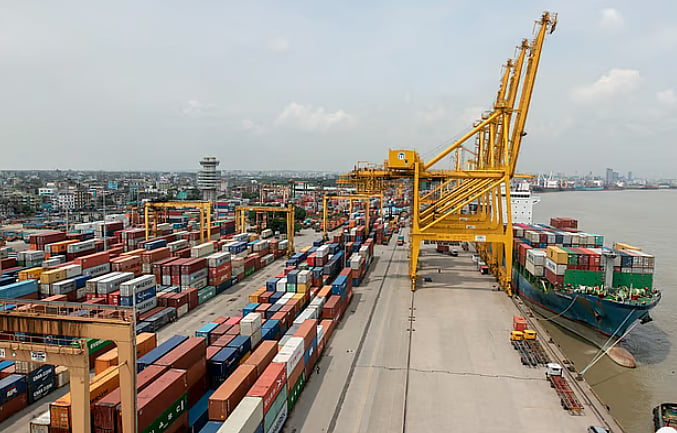
'Resource curse' refers to an economic and political situation where a country fails to achieve desired economic development despite having abundant natural resources such as oil, gas, gold, or diamonds, falling instead into economic recession, instability, and corruption. This is often called the 'paradox of plenty.' Is Bangladesh facing a similar paradox regarding the Chittagong Port?
The depth of a port is measured by its navigability, but the depth of a state is understood through the transparency of its decision-making. Therefore, the issue of handing over the operation of the New Mooring Container Terminal (NCT) of Chittagong Port to a foreign company for 15 years is not merely a matter of efficiency, investment, or profit; it is also a question of the public's right to state resources and democratic accountability in decision-making regarding those assets.

Chittagong Port: Our goose that lays the golden eggs...
Recently, an agreement was signed with the UAE-based company DP World to operate the New Mooring Container Terminal. But why was such a major national economic decision not discussed in Parliament? Why was there no perceived need for a meaningful debate in Parliament on the terms of the agreement, the financial gains and losses for the state, the future of hundreds of port workers, and issues of national security?
This question does not stem from opposition to foreign investment; rather, it arises from the demand for democratic accountability in crucial decisions like investment. An agreement may be legally valid, but that does not mean every decision within it automatically passes the test of public interest, especially when the impact of such decisions extends far beyond the tenure of the current government.