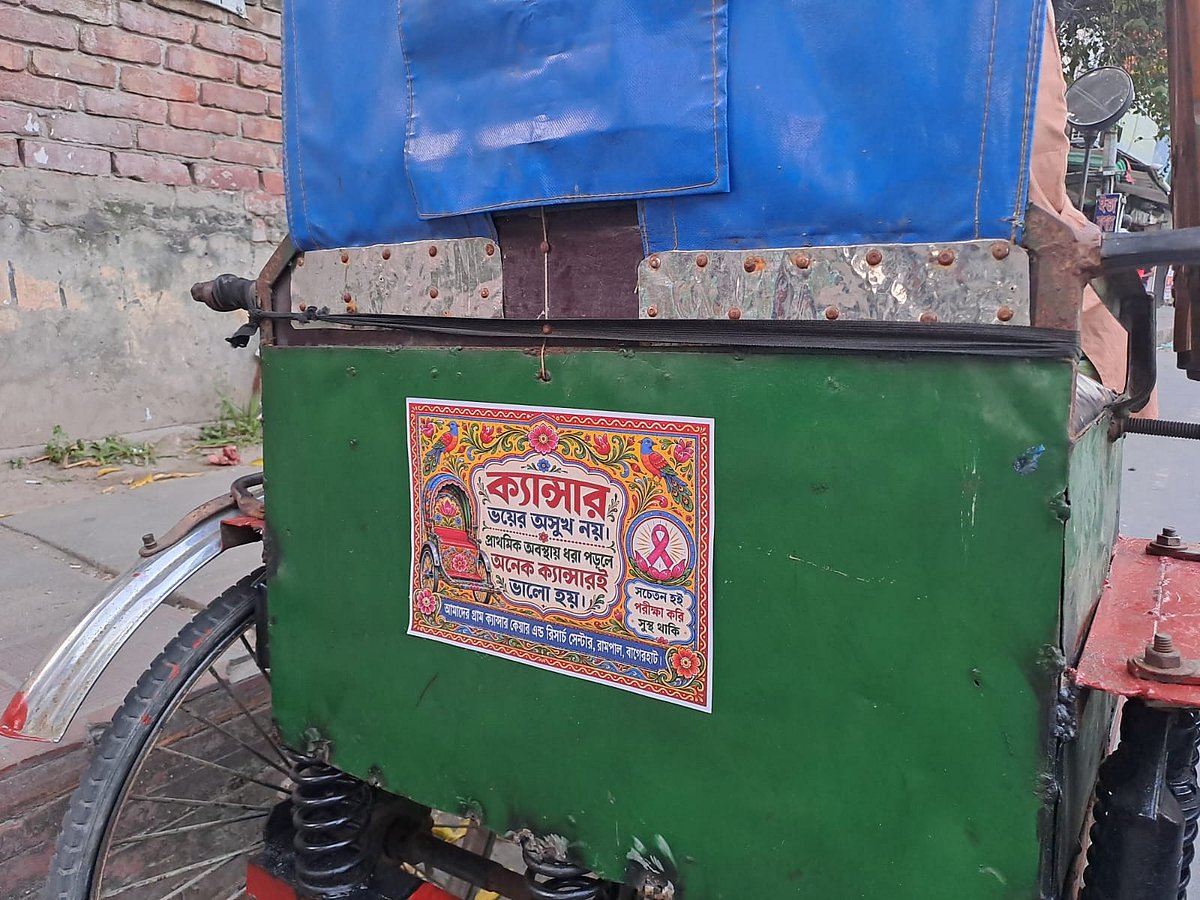
Traditional rickshaw art has been repurposed as a medium for health education by the 'Amar Gram Cancer Care and Research Center,' an initiative under the Information Technology Project for Our Village Development. Based in Rampal, Bagerhat, this pioneering effort shows that crucial health messages can be effectively communicated by leveraging local culture and familiar artistic idioms.
Vibrant designs of flowers, birds, and foliage, accompanied by familiar rural imagery of village homes, rivers, and sailboats. Amidst this recognizable scenery, bold letters proclaim: "Not all tumors are cancer." Such a sentence embedded within rickshaw art opens up novel possibilities for health education. Art forms deeply integrated into people's daily commutes and streetscapes can become powerful mediums for learning about illnesses, questioning misconceptions, and encouraging people to seek medical advice.

In Rampal, this concept has been successfully implemented by the Amar Gram Cancer Care and Research Center. Originating from a rural medical center, the initiative employs traditional rickshaw art for cancer awareness and health education, generating widespread positive local response. This has given rise to the 'Rampal Model' of health communication rooted in local art and culture.
The strength of this innovation lies in its choice of medium. By selecting an art style already familiar to the public and pairing it with urgent health messages, the primary objective is to spark conversations about health in people's everyday lives, far beyond the confines of a traditional medical facility.
Discussing cancer is never easy; the very name of the disease often evokes fear, uncertainty, and helplessness among many, while medical information itself can sometimes be daunting.