
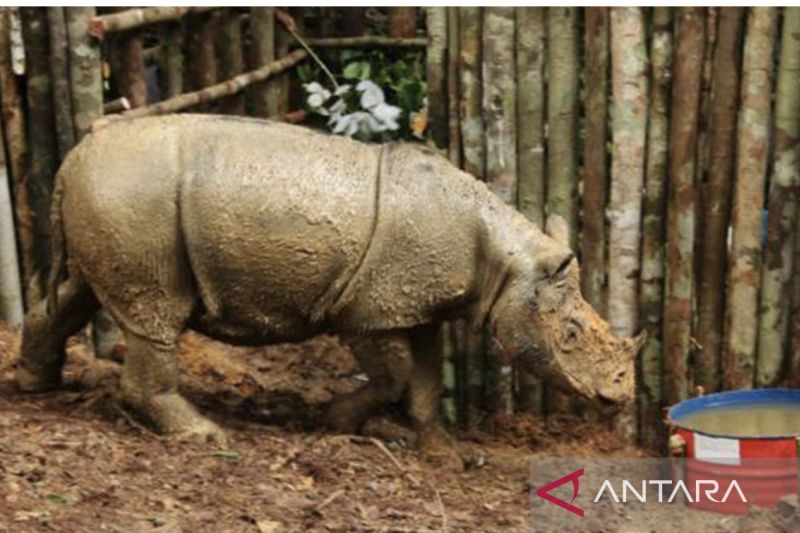
The Sumatran rhinoceros (Dicerorhinus sumatrensis) stands as one of the most unique and enigmatic creatures in the natural world. As the smallest of the five extant rhino species, it holds the distinction of being the only Asian rhino to possess two horns. The front horn is typically prominent, while the rear horn often appears as a smaller, blunt protrusion. Contrary to popular belief, these horns are not made of bone but of keratin, the same protein found in human hair and nails.
Beyond its horns, the Sumatran rhino is often referred to as the 'hairy rhinoceros.' Its body is covered in coarse, reddish-brown hair, which is particularly dense in younger individuals and becomes sparser with age. This physical trait, combined with its relatively compact size—standing about 1 to 1.5 meters at the shoulder—allows it to navigate the dense, tangled forests of its habitat with remarkable agility. Evolutionarily, the species is closely related to the extinct woolly rhinoceros, making it a living link to prehistoric times and a subject of immense interest for evolutionary biologists.

Behaviorally, the Sumatran rhino is a solitary creature. Adults typically roam their own territories, foraging for food and water independently. While they are not herd animals, they do interact during mating seasons, and mothers remain closely bonded with their calves during the rearing period. However, this solitary nature has become a disadvantage in the modern era, as habitat fragmentation makes it increasingly difficult for individuals to find mates, further complicating their already low reproductive rates.
According to the International Union for Conservation of Nature (IUCN), the Sumatran rhino is classified as 'Critically Endangered.' This status reflects the dire reality that the species faces an extremely high risk of extinction in the wild. The primary drivers of this decline are the loss of natural forest habitats and the persistent threat of illegal poaching, fueled by the illicit demand for rhino horn in black markets.
Conservation efforts are currently focused on habitat protection and intensive breeding programs to bolster the population. Experts emphasize that the survival of the Sumatran rhino is not merely about saving a single species, but about preserving the ecological integrity of the rainforests they inhabit. Without urgent and sustained intervention, the world risks losing this ancient, hairy survivor of the rhinoceros lineage forever.