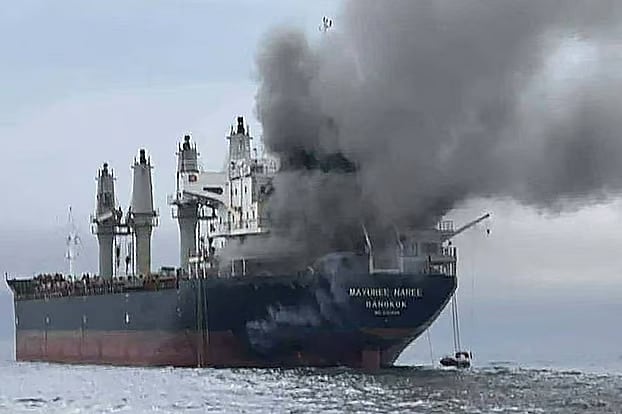
The strategic waters of the Strait of Hormuz have plunged into a severe security crisis following a coordinated series of attacks on seven oil-carrying vessels in a single night. Iran officially acknowledged the operation, asserting that the targeted tankers were linked to the United States and were navigating the vital maritime corridor under Washington's direct encouragement. This sudden escalation has sharply intensified fears of an all-out military conflict erupting across the Middle East, threatening global energy supply chains and international maritime trade.
According to regional reports, at least three of the seven vessels sustained heavy damage from naval mine explosions, while the remaining four were struck directly by elite forces of Iran's Islamic Revolutionary Guard Corps (IRGC). Tehran defended the action as a necessary response to mounting US aggression and coercive maritime blockades. Under a newly adopted defensive-offensive doctrine, the Iranian military has declared that any enforcement of unilateral maritime blockades against the Islamic Republic will be treated outright as an act of war, thereby expanding the rules of engagement in regional waters.

The IRGC has issued stern warnings against vessels transiting the strait with Western backing, accusing them of indirectly facilitating foreign geopolitical maneuvers against Iranian sovereignty. As Washington and Tel Aviv ramp up their rhetoric and war preparations, Tehran's latest show of force demonstrates its readiness to preemptively disrupt supply routes associated with its adversaries. This dynamic marks a significant departure from previous containment strategies, moving toward active deterrence within its maritime borders.
Global energy markets reacted with immediate apprehension to the disruption in the Persian Gulf, as the Strait of Hormuz remains the world's most critical chokepoint for petroleum transit. With the United States and Israel signaling readiness for potential escalations, diplomatic channels appear severely constrained. International observers warn that if more commercial tankers attempt to navigate the corridor in defiance of Iranian warnings, the probability of a wider military confrontation will increase exponentially, drawing multiple regional and global actors into the fray.