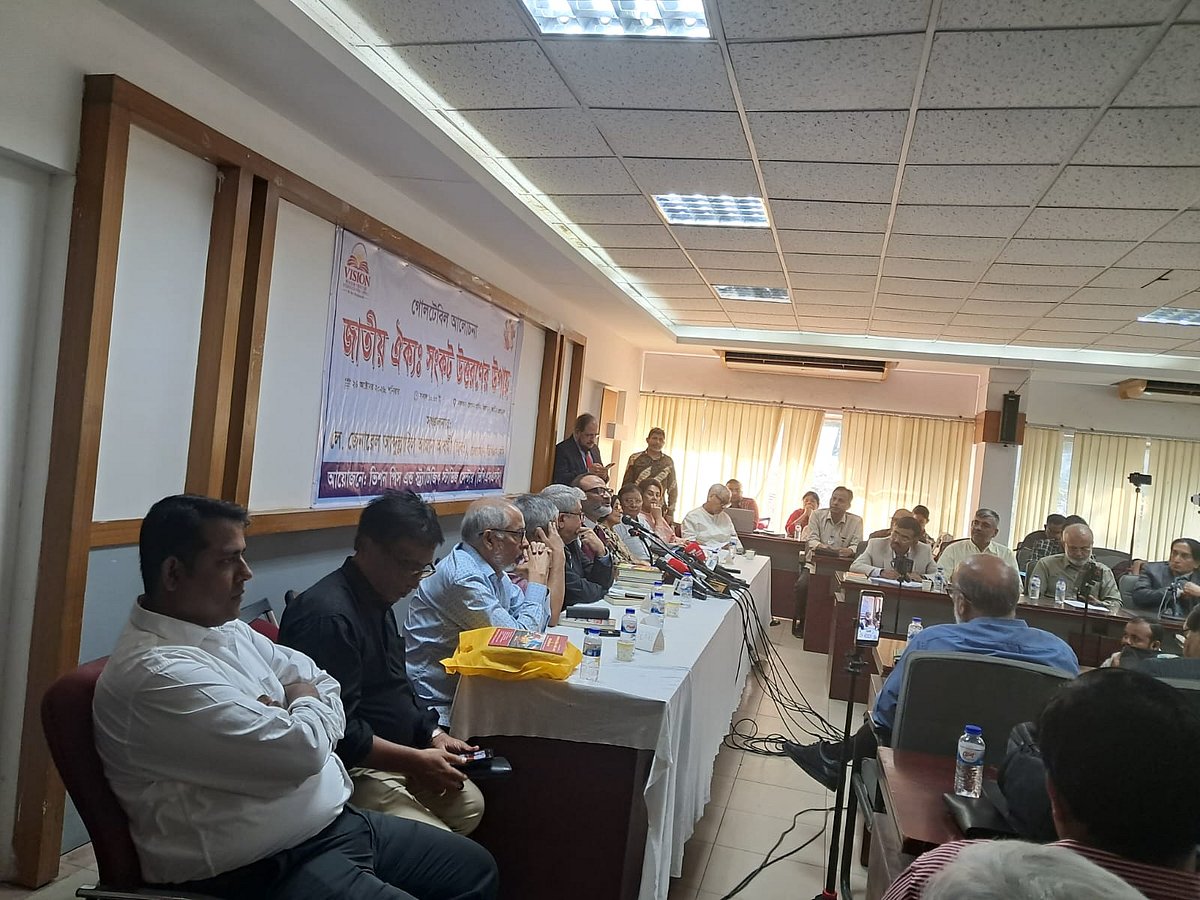
Professor Niaz Ahmed Khan, Vice-Chancellor of the University of Dhaka, has issued a stern warning regarding the potential resurgence of forces ousted during the July mass uprising. Speaking at a roundtable discussion titled 'National Unity: Ways to Overcome the Crisis,' held at the National Press Club, he emphasized that the return of these defeated elements would be catastrophic for the nation and its citizens.
Professor Khan argued that the forces displaced by the uprising remain highly influential and dangerous. He asserted that no single institution, political group, or even the government acting in isolation possesses the capacity to counter such a formidable threat. He stressed that for the sake of national survival and the stability of the country, it is imperative for all segments of society to set aside their differences and stand united. He reminded the audience that the current state of the nation is built upon the immense sacrifices and blood of many, and honoring that debt requires collective responsibility.

Reflecting on the political landscape of the past two decades, Professor Khan criticized the systematic efforts to divide society. He pointed out that state-sponsored processes were used to create artificial binaries, such as 'hardliners versus liberals' or '1971 versus 2024.' This culture of 'labeling' and creating enemies was used as a tool to dismantle individuals and institutions, severely fracturing the national fabric.
He acknowledged that there is no overnight solution to the deep-seated divisions plaguing the country. However, he insisted that identifying the roots of these divisions is the first step toward reconciliation. He urged citizens to rise above partisan politics and prioritize the success of the current administration to ensure long-term stability.
Other speakers at the event echoed these sentiments, highlighting that maintaining the spirit of the July uprising requires a unified national front. They argued that while political differences are natural in a democracy, consensus on fundamental national issues is essential. The speakers emphasized that supporting the reform initiatives of the interim government is crucial for restoring democratic norms and ensuring a stable future.
In his concluding remarks, Professor Khan expressed optimism that through the collective efforts of a conscious citizenry and patriotic forces, Bangladesh can overcome its current challenges. He envisioned a future where coexistence and mutual respect replace the divisive politics of the past, ultimately leading to a more resilient and unified nation.