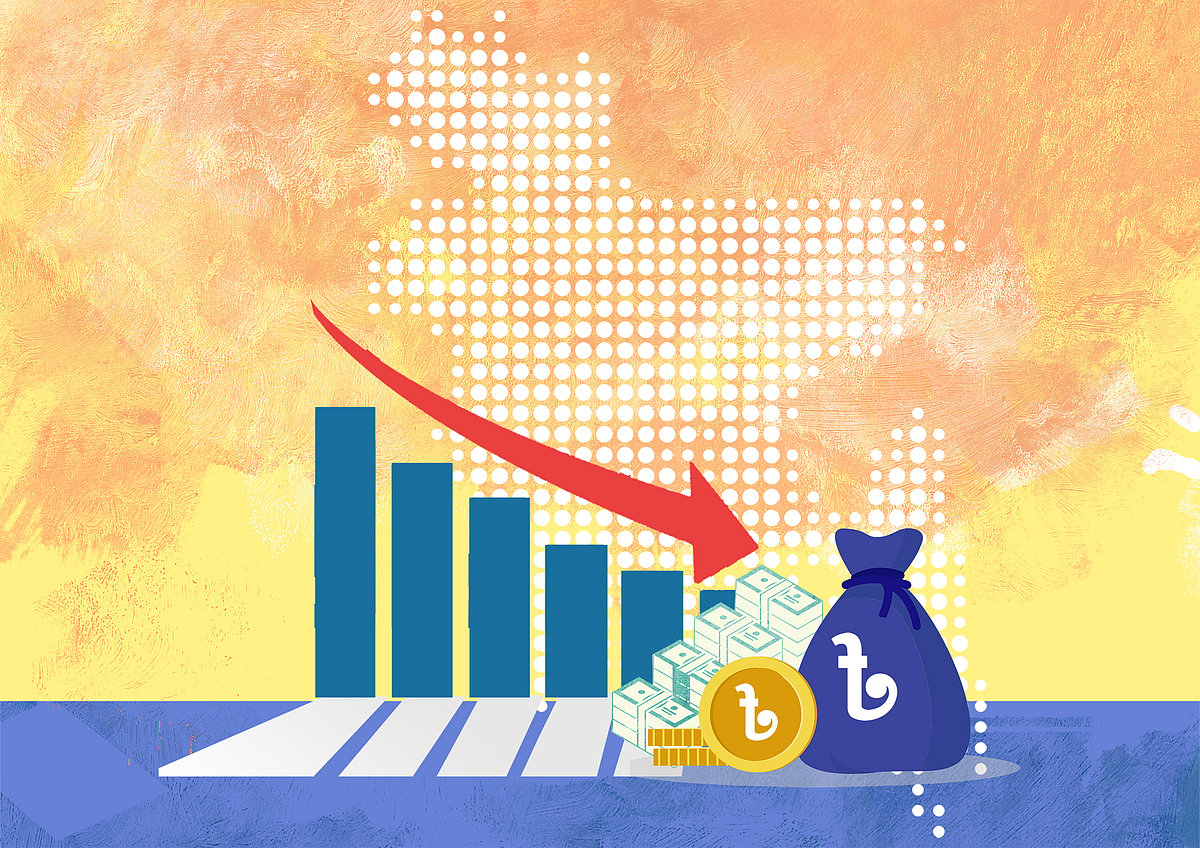
The release of fresh economic forecasts by major international financial institutions has intensified concerns regarding the trajectory of Bangladesh's macroeconomy. According to a recent report by the International Monetary Fund (IMF), the country's GDP growth could slump to 3.2 percent in the 2026-27 fiscal year. The global lender further projects that growth might decelerate even further to 2.2 percent in the subsequent fiscal year, before staging a very gradual recovery to nearly 3 percent by the 2030-31 fiscal year. In comparison, the World Bank and the Asian Development Bank (ADB) have projected growth rates of 3.4 percent and 4 percent respectively, all falling significantly short of the government's ambitious target of 6.5 percent.
Alongside subdued growth projections, inflation remains a persistent macroeconomic headache. The IMF report anticipates average inflation to hover around 10.9 percent for the same fiscal year, contrasting sharply with the government's containment target of 7.5 percent. While these international projections are not guaranteed outcomes and do not preclude the possibility of achieving government objectives, they serve as a stern warning. They indicate that engineering a swift turnaround from the current economic trajectory will require immense policy discipline and structural adjustments.

This fragile economic state is driven by a combination of external shocks and domestic structural bottlenecks. Ongoing geopolitical conflicts in the Middle East, escalating global fuel prices, and persistent bottlenecks in maritime shipping and commodity supply chains have substantially inflated import, transportation, and production costs. Since Bangladesh relies heavily on imported energy and raw materials to fuel its domestic industrial base, these external cost pressures have severely squeezed profit margins and stoked domestic price levels.
Compounding the challenges of high inflation and low growth is a noticeable sluggishness in private sector investment. With private capital expenditure remaining subdued, the generation of new employment opportunities has plateaued, plunging the broader economy into a quasi-recessionary state. Analysts argue that failure to spur job creation for the burgeoning youth demographic could pose significant socioeconomic risks in the medium to long term, necessitating urgent corrective policy interventions.
To navigate away from this growth trap and stabilize the economy, policymakers must prioritize comprehensive structural reforms. Restoring discipline in the financial sector, reining in non-performing loans, expanding the domestic revenue mobilization base, and rebuilding foreign exchange reserves are imperative steps. Without aggressive measures to revitalize private investment and foster a business-friendly ecosystem, overcoming these multi-dimensional economic headwinds will remain an uphill battle for Bangladesh.