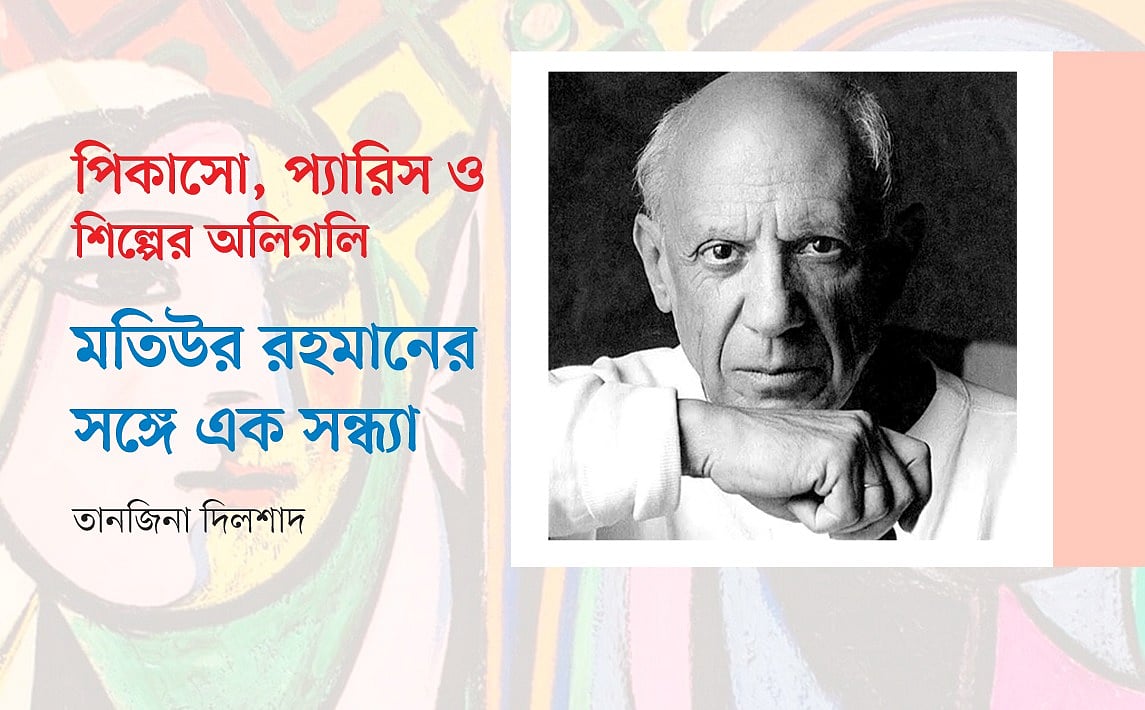
On a quiet Friday evening, a literary enthusiast walked into the office of veteran editor Matiur Rahman, where artist Mahbubur Rahman and several other creative minds were already gathered. Amidst discussions surrounding an upcoming exhibition focused on rebuilding a building that had suffered a tragic arson attack late last December, the conversation organically drifted toward the profound realms of art and human consciousness. When asked why Pablo Picasso held such a special place in his heart, the editor opened up a treasure trove of memories, art history, and philosophical reflections.
With a warm smile, Matiur Rahman noted that artists are inherently more humane and sensitive than ordinary individuals, yet Picasso stood out for a multitude of compelling reasons. He particularly highlighted 'Guernica', the monumental mural painted by Picasso in 1937 during the Spanish Civil War, which remains an eternal testament to the horrors of war and human suffering. Furthermore, Picasso's active involvement in the global peace movement following the Second World War and his iconic creation of the 'Dove of Peace' deeply resonated with generations, carrying a universal message of harmony across borders.

Delving deeper into Picasso's political ideals and artistic courage, the discussion touched upon the artist's membership in the French Communist Party. The editor recalled Picasso's profound statement in his application where he asserted that the finest sons of France—those who fought valiantly against Nazism—were communists. This unwavering commitment to human liberation and anti-fascism cemented Picasso's legacy not merely as a master painter, but as a global intellectual and humanitarian whose multifaceted life and vibrant portfolio continue to captivate art enthusiasts worldwide.
Nostalgia took over as the conversation shifted to a special issue of the literary magazine 'Ganashahitya' published back in May-June 1973, shortly after Picasso's passing. Matiur Rahman had authored a comprehensive essay titled 'Poetry of Pictures, Pictures in Poetry' for that edition, exploring the deep bonds Picasso shared with French poets and intellectuals. Their lifelong friendships and intellectual exchanges significantly influenced his artistic style, blending literary motifs seamlessly with visual aesthetics.
Recalling his days in Paris, the editor described the French capital as the beating heart of global art history during that era. Walking the same streets, visiting Picasso's former studios, and soaking in the bohemian atmosphere evoked an extraordinary sense of appreciation for how the artist captured the socio-political pulse of his time. Picasso did not merely apply paint to canvas; he translated the unspoken struggles, protests, and aspirations of humanity into a timeless visual language.
Ultimately, this engaging evening evolved far beyond a routine retrospective on Pablo Picasso, transforming into a harmonious confluence of art, literature, politics, and human resilience. It served as a powerful reminder that in the face of adversity, the enduring spirit of art continues to guide society from darkness toward enlightenment, echoing the timeless legacy of masters who dared to envision a peaceful world.