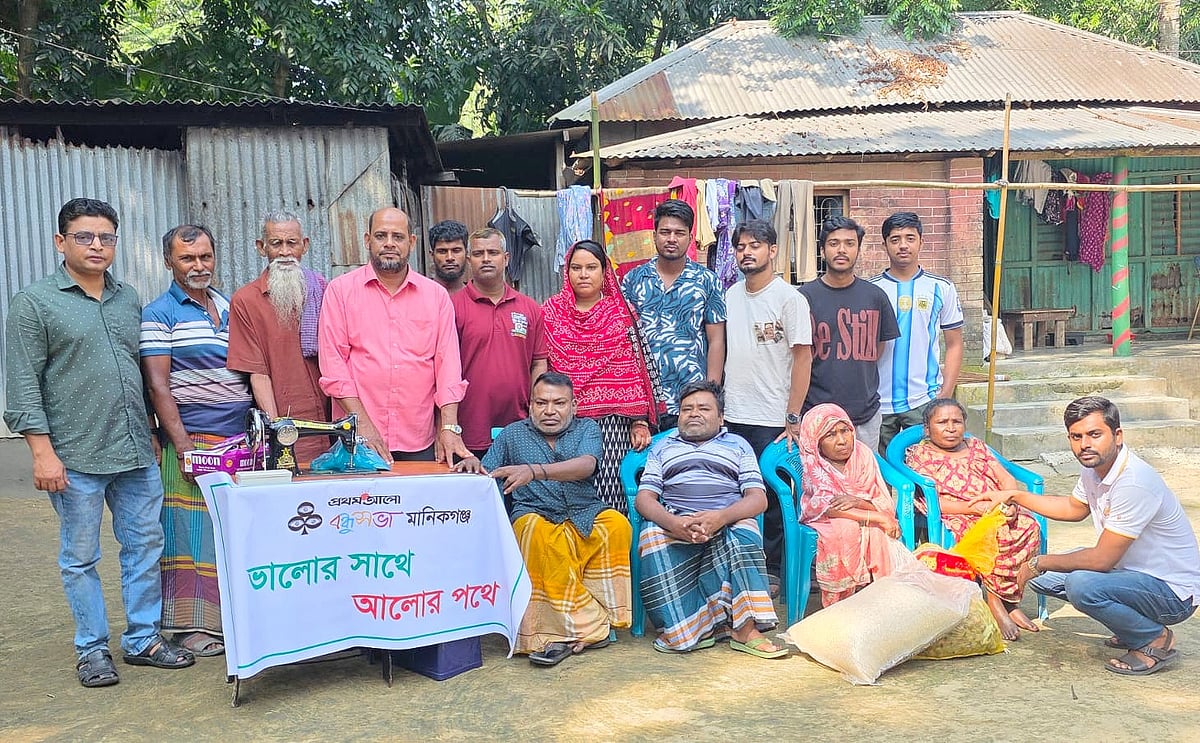
A remarkable display of empathy and social responsibility was witnessed in Manikganj as local volunteers extended a helping hand to a disadvantaged family comprising four short-statured siblings. On the morning of October 24, members of the local youth organization visited the residence of the family located in Bhatbaur village under Dighi union of Manikganj Sadar upazila. As part of their anniversary welfare initiatives, the volunteers handed over essential food items including rice and lentils, alongside a functional sewing machine to empower the household.
According to family background and local accounts, the late Hazrat Ali and elderly Zuhura Begum had five daughters and three sons, out of which four children experienced stunted growth under mysterious circumstances during their childhood. The affected siblings are Mosammat Habia (64), Meherjan (58), Izzat Ali (52), and Siraj Ali (48). Family members shared that each of them suffered from high fever around the age of seven to eight years, following which their physical growth halted permanently. Due to lack of proper medical facilities and reliance on traditional rural treatments at the time, their condition remained unchanged.

Among the four short-statured siblings, only Izzat Ali is married, while the others remain unmarried. The family faces immense hardship, particularly regarding the two sisters who cannot move independently and require constant assistance from relatives for their daily mobility. Recognizing these acute struggles, the philanthropic initiative brought a momentary sigh of relief to the distressed household.
The distribution event witnessed the presence of notable local journalists and organization leaders, including advisor Amzad Hossain, president Chan Mia, general secretary Liton Mia, vice-president Sourav Mahmud, and joint general secretary Maksudur Rahman, alongside other active members. Local women leader Jharna Akter pointed out that Meherjan possesses basic tailoring skills, making the newly gifted sewing machine an invaluable asset for her to generate a modest income and contribute to the family's financial well-being. Such community-driven interventions continue to serve as a beacon of hope for marginalized populations across rural Bangladesh.