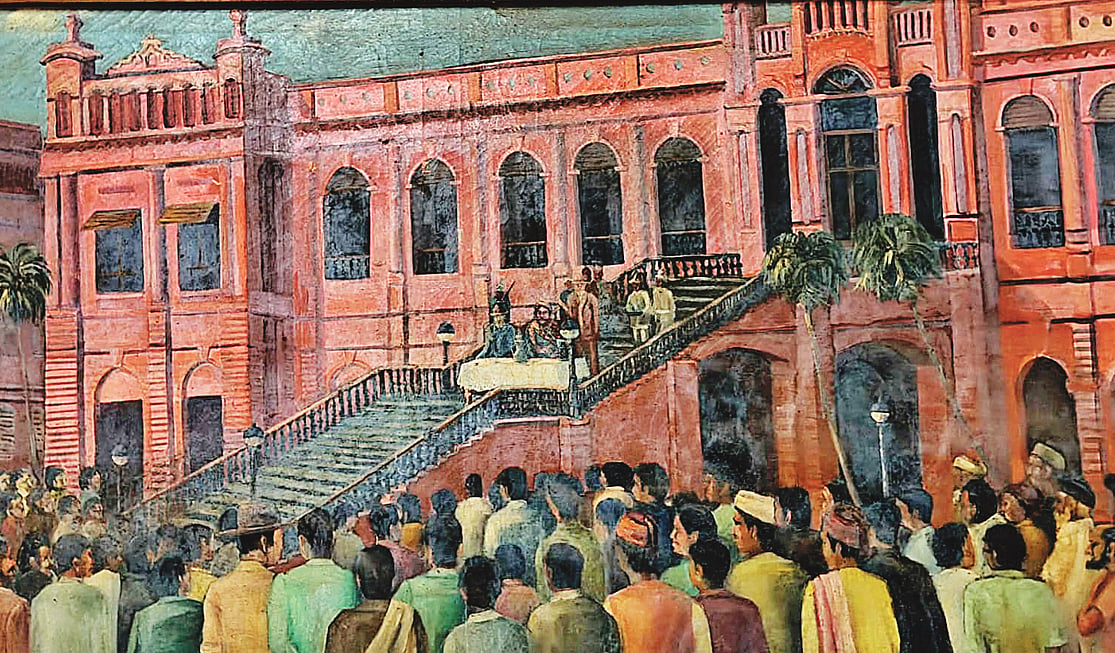
As evening descended in the past, most roads and alleys of ancient Dhaka plunged into profound darkness. People relied primarily on dim kerosene lamps or occasional gas lights for navigation, while households depended on candles and kerosene lamps for illumination. Against this backdrop, the introduction of electric lighting in the city was nothing short of a revolutionary transformation. On December 7, 1901, notable dignitaries gathered at the historic Ahsan Manzil in Dhaka. C.W. Bolton, the Secretary of the Board of Revenue from Calcutta, arrived as a special guest upon the invitation of Nawab Ahsanullah. Around 5:00 PM, he pressed the electrical switch, illuminating the surroundings in a magical glow.
This momentous event was organized entirely through the visionary initiative of Nawab Ahsanullah. Initially, Sir John Woodburn, the Lieutenant Governor of Bengal, was scheduled to grace the inauguration as the chief guest. However, due to sudden illness, he could not travel to Dhaka, prompting Secretary C.W. Bolton to officially inaugurate the electric lighting system. It is noteworthy that the entire city was not brought under the power grid on that very day. During the initial phase, electric lights were installed only within Ahsan Manzil and a few critical thoroughfares, serving as a powerful precursor to future urban modernization.

Detailed records preserved in Gallery 20 of the Ahsan Manzil Museum provide authentic accounts of that historic day. Driven by a desire to alleviate the sufferings of city dwellers, enhance Dhaka's aesthetic beauty, and propel the city into the modern era, Nawab Ahsanullah spent approximately four hundred and fifty thousand taka. For that era, investing such a massive amount of private capital to introduce electricity stood out as a monumental philanthropic achievement by the Nawab family, setting a high benchmark for urban development.
The day after the event, on December 8, 1901, the contemporary newspaper 'Dhaka Prokash' published a vivid report praising the breakthrough. Renowned historian Muntassir Mamoon, in his book 'Dhaka Samagra 1', cited the newspaper's report, describing how the main streets of Dhaka suddenly lit up with electric brilliance under the benevolence of the Nawab. The report noted that witnessing such a spectacle in a city like Dhaka would have seemed unimaginable even a decade prior, but the Nawab's grace turned the impossible into reality.
Subsequently, this pioneering introduction of electric illumination left a far-reaching impact on the civic amenities and infrastructural evolution of Dhaka. Moving beyond the era of gas and kerosene, the city steadily embraced modern civilization. Nawab Ahsanullah's visionary endeavor not only illuminated a royal palace and select streets but also paved the way for broader regional modernization. The glittering, modern Dhaka of today traces its foundational roots back to that winter evening in 1901 when the first electric switch was pressed, illuminating a new chapter in the city's history.