


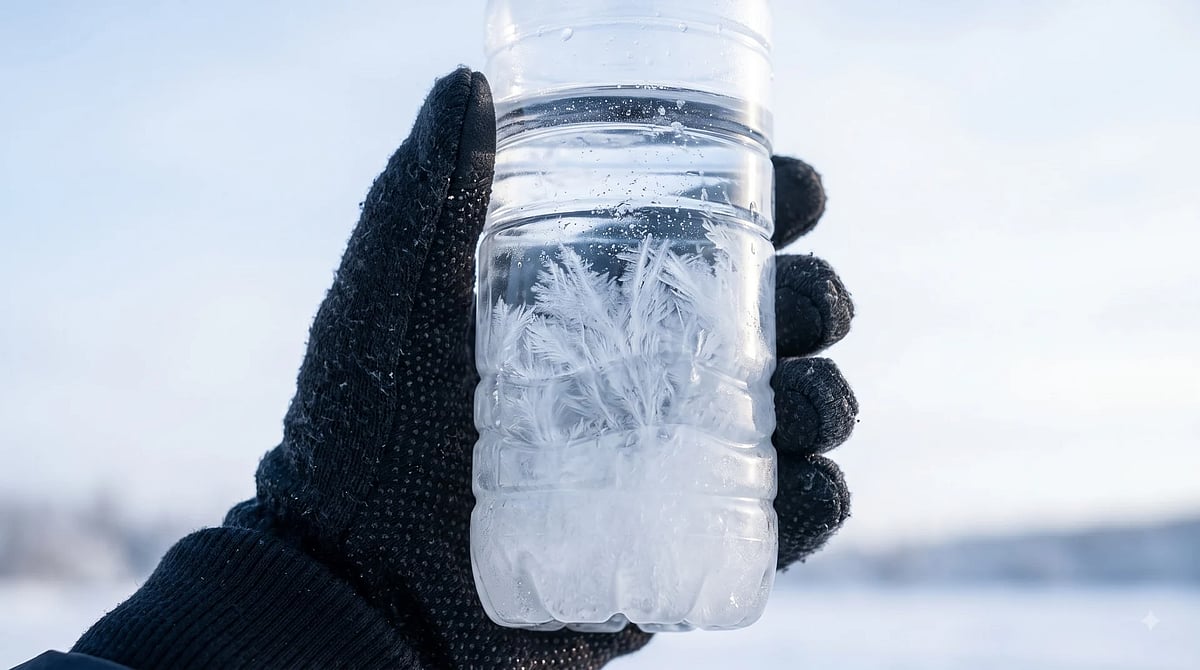
The process of water turning into ice does not depend solely on temperature; rather, it often requires a specific nucleation starting point. If the formation of this starting point is delayed in clean and stationary water, the liquid can remain in a fluid state even when the temperature drops well below the freezing point. In scientific terms, this extraordinary state is known as supercooling. Physicists note that pure water stored in a clean bottle inside a freezer can remain entirely liquid even at severe temperatures such as minus ten degrees Celsius. However, a slight tap or physical agitation to the bottle can instantly trigger the ice-formation process. Once a stable ice crystal forms, more ice rapidly accumulates around it.
Nevertheless, shaking water does not always cause it to freeze immediately, as the outcome depends heavily on water purity, ambient temperature, container surface characteristics, and other external conditions. Similarly, naturally flowing river water can occasionally become slightly supercooled and form frazil ice. On the other hand, supercooled raindrops freeze instantly upon contacting a cold surface. This exact thermodynamic process is also responsible for ice accumulation on aircraft wings at high altitudes, which can pose significant safety hazards during flight.

During the phase change from liquid to ice, a specific amount of latent heat is released. Because of this released heat, a supercooled bottle of water typically does not freeze completely all at once. Studies indicate that for water at minus ten degrees Celsius, the freezing of roughly one-eighth of the total volume releases enough heat to warm the remaining water back up to zero degrees Celsius, resulting in a slushy mixture of ice chips and water rather than a solid block.
This fascinating physical principle shares similarities with another intriguing phenomenon frequently observed in kitchens. Inside a microwave oven, water can sometimes be superheated beyond one hundred degrees Celsius without visibly boiling. If the cup is subsequently moved or disturbed, violent bubbling can occur instantly, causing the scalding water to splash out and potentially cause burns. These remarkable scientific principles continually unveil the deep physical truths hidden behind ordinary, everyday occurrences.


