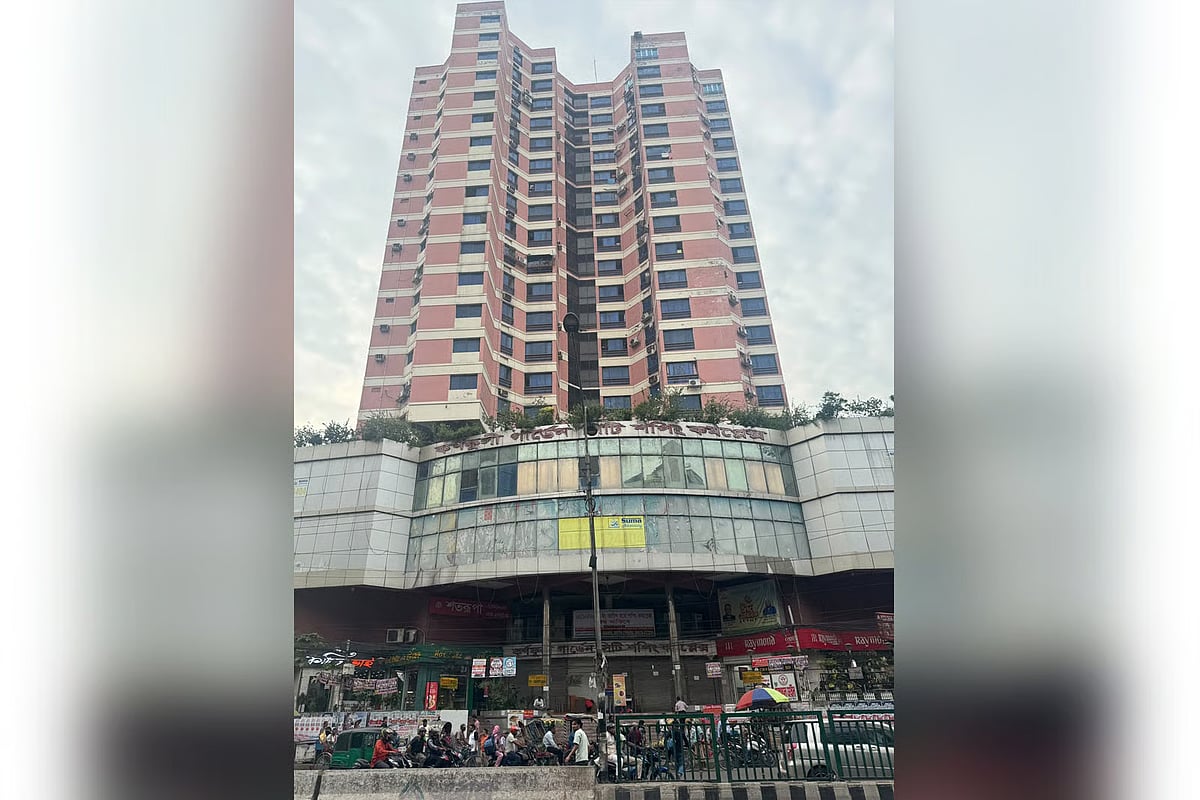
The iconic Karnaphuli Garden City shopping complex, once a bustling hub for middle- and upper-income shoppers in Dhaka's Kakrail area, has officially closed its doors. Faced with a prolonged customer shortage, dwindling sales, and mounting financial losses, the business owners unanimously decided to shutter the entire complex starting 1 October. Established in the late 1990s, the upscale shopping center was renowned for offering a wide array of ready-made garments, footwear, cosmetics, and jewelry.
A recent visit to the location revealed that the main entrance of the shopping complex was firmly shut, adorned with a PVC banner explicitly stating the closure. While the main gates remained barred, a handful of shops on the periphery and an ATM booth continued to operate, alongside a couple of food outlets serving a sparse number of customers. The twenty-storey building houses residential apartments on its upper floors, while the basement and the first four floors originally constituted the commercial shopping complex.

Developed by the Karnaphuli Group, the commercial space was divided among 125 businesspeople who purchased ownership rights to its 198 shops. Over the years, however, the complex gradually lost its competitive edge. Factors such as changing urban consumer habits, traffic congestion in the area, parking constraints, and the rapid rise of modern shopping malls and e-commerce platforms across Dhaka drastically eroded its customer base.
Leaders of the Karnaphuli Garden City Shop Owners' Association noted that despite their best efforts to sustain operations, the drop in footfall made it impossible to bear ongoing operational costs and utility expenses. Consequently, the owners reached a consensus to close down the physical market entirely and explore options to sell their respective ownership interests.
The permanent closure of Karnaphuli Garden City highlights the shifting dynamics of Dhaka’s retail landscape. As newer, more integrated lifestyle malls emerge across the metropolis, traditional standalone shopping centers face severe existential challenges unless they undergo comprehensive modernization and strategic adaptation to meet contemporary consumer demands.