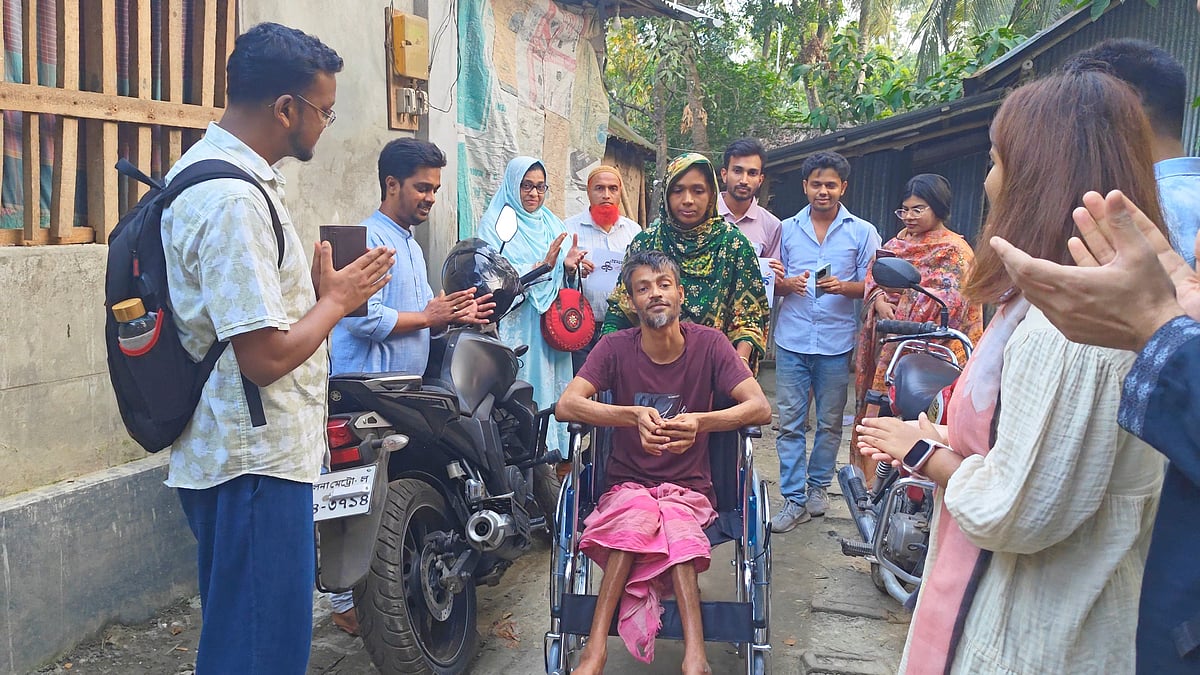
Five years ago, a tragic fall from a tree shattered the life of Sobuj Mia, a daily wage earner from Khulna. The accident resulted in a severe spinal injury, leaving him bedridden and unable to move without assistance. Once the primary breadwinner for his family, Sobuj found himself trapped in a cycle of dependency and despair. However, a recent humanitarian initiative by the Khulna Bondhushava has brought a ray of hope into his stagnant life.
As part of their anniversary program titled 'A Good Deed,' members of the organization visited Sobuj’s home in the Panigati Union of Dighalia Upazila on the afternoon of October 23. They presented him with a wheelchair, a gift that moved him to tears. Expressing his gratitude, Sobuj remarked, 'Give this to me; I want to see the light and air of the world again.' For a man who had been confined to his bed for half a decade, the wheelchair represents a newfound sense of freedom and connection to the outside world.

The economic condition of Sobuj’s family is dire. With no land other than their ancestral homestead, the family has been struggling to survive since Sobuj’s injury. The burden of supporting the five-member household has fallen on his wife and young children. His eldest son, only nine years old, works as a helper at a local jute mill, earning a meager 1,300 taka per week. At an age when he should be in school, he is forced to labor to keep the family afloat. Meanwhile, Sobuj’s wife works as a domestic helper to supplement their minimal income.
Hafizur Rahman, Vice President of Khulna Bondhushava, emphasized that the organization’s core mission is to stand by those in need. He noted that such small gestures can provide immense courage to individuals who have been marginalized by their physical circumstances. The initiative has been widely appreciated by the local community.
While the wheelchair significantly improves Sobuj’s mobility, his long-term recovery remains a challenge requiring advanced medical care and rehabilitation. Local observers suggest that sustained support from both government and private sectors is essential to help families like Sobuj’s escape the cycle of poverty. For now, the wheelchair serves as a vital symbol of hope and resilience for the family.